Blown-In Insulation Cost in Bothell, WA
Blown-in insulation cost in Bothell depends on four things: how many square feet you are covering, which loose-fill material you choose, how deep it needs to go to reach your target R-value, and how much prep the space needs first. This page explains each of those factors, walks you through an estimate worksheet for your own home, and shows how to get a written quote from Bothell Insulation Pros after a free inspection.
Bothell sits in a mild but damp marine climate, so most homes lose heat slowly through the attic for much of the year. Topping up or replacing attic insulation, and sometimes dense-packing empty wall cavities, is one of the most common energy upgrades we quote. For other project types, see our full insulation cost guide.
At a glance
How much does blown-in insulation cost in Bothell?
Blown-in insulation cost in Bothell is set by the size of the area, the material, the depth needed for your target R-value, and the access and prep work. We provide a written quote after a free inspection rather than a flat price.
National cost guides publish a wide per-square-foot range for installed blown-in insulation, and a wide total range for an average attic. The spread is wide because "blown-in insulation" covers very different jobs. A simple top-up over clean, existing insulation in an open, walk-able attic sits at the low end. A deep R-60 install in a low-pitch attic that first needs old insulation removed, air sealing and new baffles sits at the high end. Wall projects are priced differently again, because they involve drilling, dense-packing and patching.
| Cost factor | What raises the price | What keeps it lower |
|---|---|---|
| Area size | Large footprint, multiple attic sections | Single, compact attic |
| Material | Mineral wool or specialty wool loose-fill | Standard fiberglass or cellulose |
| R-value and depth | R-49 to R-60 from a low starting level | Small top-up over decent existing insulation |
| Access and pitch | Low-slope roofs, tight hatches, crawl-only attics | Tall, open attic with a good hatch |
| Prep work | Air sealing, baffles, hatch insulation, recessed light covers | Attic already sealed and baffled |
| Tear-off | Removing wet, moldy, rodent-damaged or compressed insulation | Existing material can stay |
| Damage and permits | Repairs after leaks or pests, permit requirements | Straightforward retrofit |
Because size is the biggest single driver, most homeowners first want to understand pricing on a per-square-foot basis.
At a glance
What is the blown-in insulation cost per square foot?
The blown-in insulation cost per square foot depends mainly on material type and installed depth. Fiberglass and cellulose are usually the most budget-friendly, while mineral wool and specialty wool cost more.
Published guides quote a lower per-square-foot band for standard fiberglass or cellulose and a noticeably higher band for attic-specific quotes. Attic quotes run higher because they include depth to a full code-level R-value plus access, baffles and air sealing.
| Material | Relative cost per sq ft | Approx. R-value per inch | Notes |
|---|---|---|---|
| Loose-fill fiberglass | Lower | About 2.2 to 2.9 | Light, does not absorb water, needs more depth for the same R-value |
| Blown-in cellulose | Lower | About 3.2 to 3.8 | Denser, good air resistance, used for dense-pack walls |
| Mineral wool loose-fill | Higher | About 3.0 to 3.3 | Fire and moisture resistant, less widely stocked |
| Specialty wool (e.g., sheep's wool) | Highest | Varies by product | Niche product, limited availability |
Attic work is priced by floor area. Walls are priced around the number of cavities and how hard they are to reach.
Free, no-obligation estimates
Talk to Bothell Insulation Pros
Tell us what you need and we’ll take it from there.
At a glance
How much does it cost to get insulation blown into your walls?
The blow-in wall insulation cost depends on wall area, the number of stud bays, the siding or interior finish you drill through, and how much patching and paint matching is needed afterward.
Wall retrofits use a "drill-and-fill" process:
- We inspect the walls for wiring, fire blocking and moisture.
- We drill holes into each stud bay, from the exterior under removed siding or from the interior.
- We dense-pack cellulose or fiberglass through a tube until the cavity is full.
- We plug and patch the holes and reinstall siding.
| Factor | Attic blown-in | Wall blown-in |
|---|---|---|
| Pricing basis | Attic floor sq ft and depth | Wall sq ft and cavity count |
| Installation method | Open blow over attic floor | Dense-pack through drilled holes |
| Main prep | Air sealing, baffles, removal | Siding removal, hole drilling, wiring check |
| Finish work | Minimal | Plugging, patching, paint or siding |
| Cost per sq ft | Usually lower | Usually higher, because of labor |
For more on wall projects, see our wall insulation service. For most Bothell homes, though, the attic is where blown-in makes the biggest difference, and depth drives that price.
At a glance
Blown-in attic insulation cost by R-value and depth
Blown-in attic insulation cost rises with target R-value, because higher R-values such as R-49 or R-60 need thicker layers and more bags of material.
Bothell is in a marine climate zone where current energy guidance and Washington's energy code point to roughly R-49 or more in attics. Many older homes have far less.
| Target R-value | Approx. fiberglass depth | Approx. cellulose depth | Material needed |
|---|---|---|---|
| R-30 | About 11 to 14 in | About 8 to 10 in | Moderate |
| R-38 | About 13 to 17 in | About 10 to 12 in | More |
| R-49 | About 17 to 22 in | About 13 to 15 in | Substantially more |
| R-60 | About 21 to 27 in | About 16 to 19 in | Most |
These depths are general guides. The product's own coverage chart is the final authority. Existing insulation in good condition counts toward the total, which lowers the material needed. Our attic insulation cost in Bothell page covers attic-only factors in more detail. Material choice also changes how many inches and bags you need.
Blown-in cellulose vs. fiberglass: which costs more?
Blown-in cellulose insulation cost and fiberglass cost are usually close per square foot, and either can come out cheaper depending on the R-value target and the job conditions.
- Cellulose reaches a given R-value in fewer inches and resists air movement well. It is the standard choice for dense-packing walls. It is heavier and should stay dry.
- Fiberglass is lighter, does not absorb moisture, and does not settle much. It needs more depth for the same R-value.
- Mineral wool and specialty wool cost more than either one and are chosen for specific fire or material preferences.
Once you have chosen a material, you can rough out your own project using the worksheet below.
At a glance
Blown-in insulation cost calculator
Use this blow-in insulation calculator worksheet to gather the same inputs we use, so you can estimate the scope of your project before an inspection.
| Input | What to enter | How it affects the estimate |
|---|---|---|
| Square footage | Attic floor area (usually your top-floor footprint) or wall area | Sets the total bag count and labor |
| Area | Attic, exterior walls, or both | Walls add drilling and patching |
| Material | Fiberglass, cellulose, mineral wool | Changes the per-sq-ft rate and depth |
| Target R-value | R-30, R-38, R-49 or R-60 | Higher targets need more material |
| Removal needed | Yes or no | Adds tear-off, vacuum and disposal |
To use it:
- Measure the area.
- Pick a material and a target R-value.
- Read the bags needed from the manufacturer's chart.
- Flag any removal, air sealing or baffles needed.
Disclaimer: Any blown insulation cost calculator result is an estimate only. Hidden air leaks, moisture, pests, access limits and existing insulation condition change the real number. A free inspection from Bothell Insulation Pros gives you the exact, written price.
The most important input is the depth you are aiming for.
How thick should my blown-in insulation be in my attic?
For most Bothell attics, blown-in insulation should be thick enough to reach about R-49. That typically means roughly 13 to 15 inches of cellulose or 17 to 22 inches of fiberglass, after settling.
Use the "minimum settled thickness" on the bag's coverage chart, not the installed thickness. Loose-fill settles somewhat after installation. Depth rulers stapled to framing let you and any inspector confirm the depth. Keep insulation off recessed lights that are not rated for contact, and keep it behind baffles at the eaves so soffit vents stay open. Once you know the depth, you can work out the bag count.
How many bags of blown insulation do I need for 1,000 square feet?
The number of bags for 1,000 square feet comes directly from the manufacturer's coverage chart printed on the bag. Find the row for your target R-value and read the bags-per-1,000-sq-ft column.
- Charts differ between brands and between fiberglass and cellulose, so use the chart for the exact product you buy.
- Each row also lists the minimum thickness and maximum coverage per bag.
- For areas other than 1,000 sq ft, divide your square footage by 1,000 and multiply by the chart figure.
- If you have existing insulation, subtract its R-value from your target first.
- Add a small margin for uneven framing and waste.
Bag count leads to the bigger question of whether the investment pays off.
At a glance
Is blown insulation worth it, and what are the downsides of blown-in insulation?
Blown insulation is usually worth it in Bothell attics with low or uneven coverage, because it fills gaps around framing and obstructions better than batts. It does have downsides you should plan for.
- Settling: Loose-fill settles, especially cellulose, so it should be installed to the chart's settled depth.
- Air leaks: Insulation does not stop air, so attics need air sealing first.
- Moisture: Cellulose can be damaged by roof leaks.
- Attic storage: Deep insulation makes walking and storing items in the attic difficult.
- Dust: Installation is messy without proper equipment.
| Item | DIY | Professional |
|---|---|---|
| Material | Bags bought at retail, priced per bag | Included in the quote |
| Equipment | Blower rental; extra bags add to the total | Commercial blower included |
| Prep | Air sealing and baffles are often skipped | Air sealing, baffles and depth markers |
| Removal | Very difficult without a high-power vacuum | Handled as part of the job |
| Risk | Uneven depth, blocked vents | Consistent coverage |
If your existing insulation is damaged, the project changes from a top-up to a replacement.
How to replace attic insulation and what it adds to the price
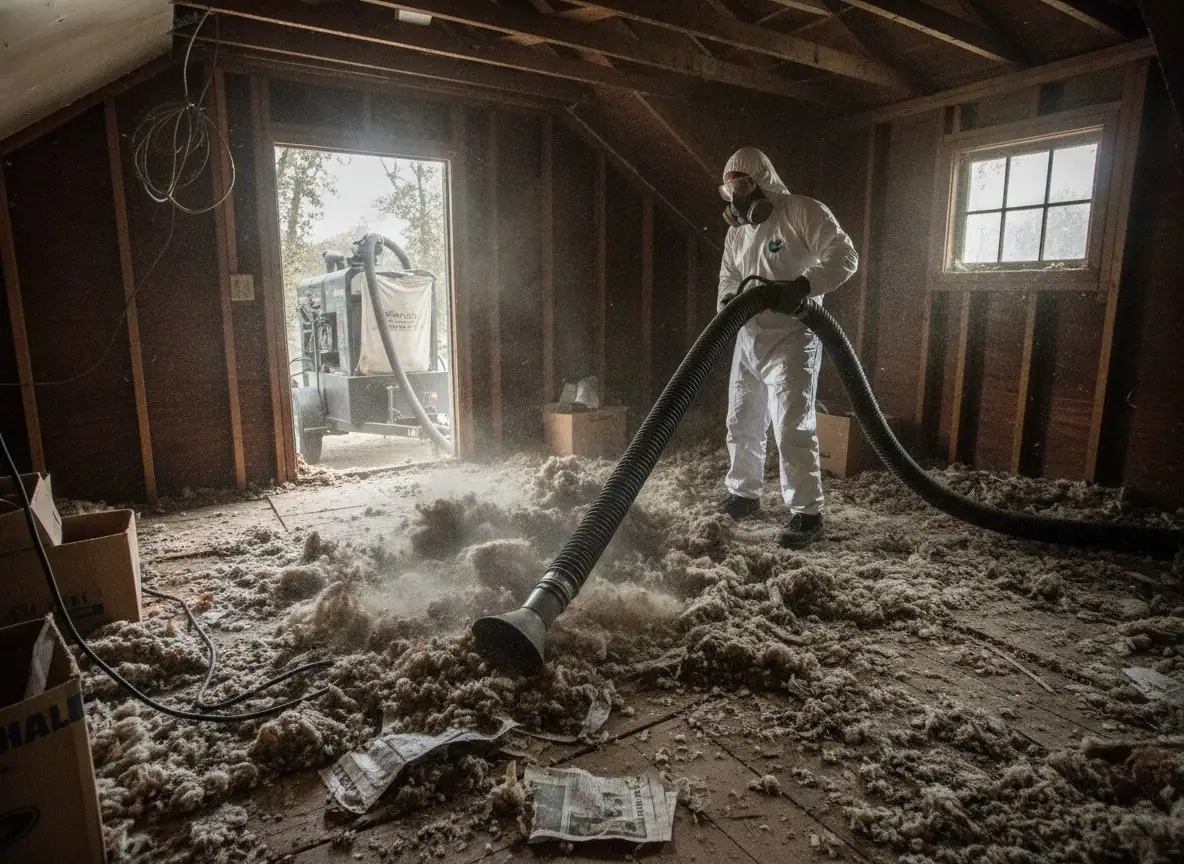
Replacing attic insulation adds tear-off, vacuum removal, disposal and cleanup to the price. The extent of the damage largely determines how much the total increases.
- We inspect for moisture, mold, rodent activity and roof leaks.
- We remove the old insulation with a high-powered vacuum and bag it for disposal.
- We clean and sanitize the attic if needed.
- We air seal the top plates, penetrations and the hatch.
- We install baffles at the eaves.
- We blow in new insulation to the target depth with depth markers.
See our insulation removal cost page and our insulation replacement service. If the damage followed a covered event, we help homeowners with insurance claims. For hard-to-seal areas, compare spray foam insulation cost.
Financing available: Bothell Insulation Pros offers financing, so a full removal and re-insulation can be spread over time. Ask about it during your inspection.
All of these variables come together in a written quote.
How do you get an exact blown-in insulation quote?
You get an exact blown-in insulation quote by scheduling a free inspection. We measure the area, check existing insulation and air leaks, and then provide a written price.
During the visit, we confirm the square footage, current R-value, access, ventilation and any removal needs. Then we recommend material and depth options. As a Bothell insulation company offering blow-in insulation, attic, wall and crawl space work, we can quote several areas at once. We also offer 24/7 emergency service when water or pest damage cannot wait. Call (425) 528-8317 or use the free estimate form on this page.
FAQ
Frequently asked questions
Is blown-in cellulose cheaper than fiberglass?
Sometimes. Material prices are close. Cellulose needs fewer inches for the same R-value, while fiberglass bags are lighter and cover more volume. The cheaper option depends on your target R-value and your attic conditions.
Does blown-in insulation settle over time?
Yes. Cellulose settles more than fiberglass. Manufacturers list a settled thickness, and installing to that figure keeps your R-value on target.
Can blown-in insulation go over existing insulation?
Yes, if the existing insulation is dry, clean and free of mold or pests. Damaged material should be removed first.
How long does a blown-in attic insulation job take?
A typical attic top-up usually takes about a day. Jobs that include removal, air sealing or wall dense-packing take longer. We confirm the timing in your quote.
Is blown-in insulation safe for walls in older Bothell homes?
Usually, after an inspection. Older homes may have knob-and-tube wiring or moisture issues that must be addressed before any walls are filled.
Are there rebates or utility incentives for adding insulation?
Possibly. Bothell is served by Puget Sound Energy and, in the Snohomish County portion, by Snohomish County PUD. Check with your utility for current insulation rebates, and confirm the status of any federal tax credits before you rely on them.
Ready for an exact number? Call (425) 528-8317 to schedule your free inspection with Bothell Insulation Pros.
Why choose us
Why choose Bothell Insulation Pros?
Free estimates
Get a clear, no-obligation estimate before any work begins.
Licensed & insured
Your property and our crew are protected on every project.
Residential & commercial
One team for homes, multi-family and commercial properties.
Locally owned & operated
A local team serving your community and the surrounding area.
Get in touch
Find insulation help near you
Request a free estimate online or give us a call — our team will follow up quickly.
- Call us(425) 528-8317
- Visit19125 N Creek Pkwy Ste 120 A, Bothell, WA 98011
- HoursMon-Sun: 7:00 am – 7:00 pm